Versatile System for Precision Single-Cell Manipulation
The FluidFM® OMNIUM Platform by Cytosurge is an advanced semi-automated system designed for precise manipulation of individual living cells. Built around the proprietary FluidFM® (Fluidic Force Microscopy) technology, the OMNIUM platform uniquely combines microfluidics with Atomic Force Microscopy (AFM), enabling highly controlled interaction with single cells in a non-destructive manner.
This powerful integration allows researchers to inject, extract, measure, and manipulate living cells with nanometer precision, opening new possibilities in single-cell biology, mechanobiology, and drug discovery. The system supports workflows ranging from single-cell transfection and temporal transcriptomics to mechanical characterization of cells, all while preserving cell viability.
FluidFM® Technology – Combining Microfluidics and Force Microscopy
At the heart of the OMNIUM platform lies Cytosurge’s proprietary FluidFM technology, a unique approach that integrates closed microfluidic channels inside force-sensitive AFM probes. These specialized probes feature apertures as small as 300 nm, allowing them to aspirate or dispense femtoliter volumes of liquid while simultaneously measuring interaction forces down to the piconewton scale.
This dual capability provides exceptional control when interacting with biological samples. The integrated force feedback mechanism allows the system to precisely distinguish between gentle contact with the cell membrane and controlled membrane penetration, ensuring safe and reproducible experiments.
Thanks to this design, FluidFM enables a range of experimental operations that were previously extremely difficult or impossible with conventional methods.
Non-Destructive Manipulation of Living Cells
The FluidFM OMNIUM platform enables researchers to interact with living cells without compromising their viability. Whether working with the cytoplasm or nucleus, the system performs gentle nano-injection or nano-extraction, making it possible to retrieve cellular material or introduce biomolecules while keeping the same cell alive for further study.
This capability unlocks the frontier of Same-Cell biology, enabling researchers to conduct longitudinal experiments where the exact same cell is revisited multiple times. Instead of observing a single snapshot, researchers can now track the true evolution of cellular responses over time.
Typical experimental capabilities include:
Semi-Automated Workflows and User-Friendly Operation
The OMNIUM platform is designed to simplify complex single-cell experiments through semi-automated workflows and intuitive software control. Using a point-and-click interface, researchers can easily select individual cells and define experimental actions such as injection, sampling, or mechanical measurements.
The software records the exact XY coordinates of edited cells, enabling users to relocate and revisit the same cells during longitudinal experiments. Automated positioning of the probe reduces operator variability and increases experimental reproducibility. This highly intuitive software ensures a quick learning curve and is fully backed by Cytosurge’s dedicated team of application experts, always on hand to troubleshoot, provide hands-on training, and help optimize your specific experimental workflows.
Integrated Standalone System
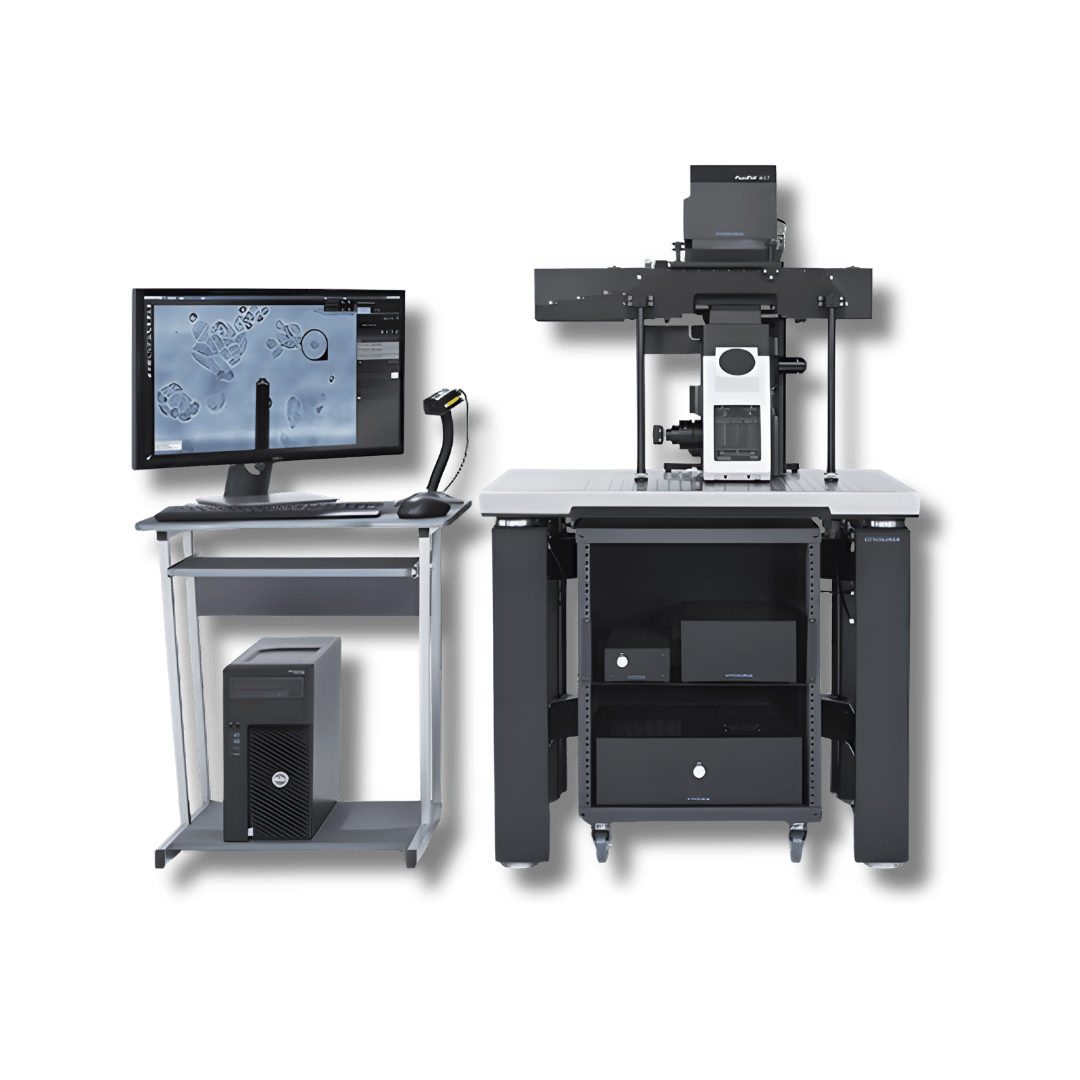
FluidFM OMNIUM is delivered as a fully integrated and motorized platform that combines several key components into a single system:
The system uses optimized FluidFM probes filled with less than 1 µL of solution, minimizing reagent consumption and eliminating dead volume.
FluidFM Probe Types and Operation Modes
FluidFM technology supports several probe types and operational modes designed for different experimental needs.
Injection & Sampling
Biomolecules can be injected into individual cells, or intracellular material can be extracted for downstream analysis.
Pick & Place
Single cells or microscopic objects can be captured and repositioned with high precision.
Localized Dispensing & Nanoprinting
Extremely small quantities of liquids can be dispensed locally, enabling nanoscale patterning and controlled surface modification.
Several probe types are available, including:
Key Application Areas
The FluidFM OMNIUM platform is widely used in cutting-edge research across multiple disciplines.
Temporal Single-Cell Profiling
Researchers can extract small amounts of cytoplasm from the same cell at multiple time points, enabling longitudinal transcriptomic analysis and the study of cellular dynamics.
Mechanobiology
The force-sensing capability of FluidFM allows measurement of cell adhesion forces and mechanical properties in physiologically relevant environments.
Additional Applications
FluidFM technology is also applied in neuroscience, virology, synthetic biology, drug discovery, and fundamental studies of cellular mechanics.
Need Cell Line Development Services? For teams looking to accelerate their CRISPR and cell line engineering research without bringing an instrument in-house, Cytosurge leverages this exact same FluidFM technology to offer expert, custom Cell Line Development services.
Proven Technology and Global Adoption
Since its introduction in 2009, FluidFM technology has become a powerful tool in advanced life-science research. Today, more than 120 FluidFM systems are installed worldwide, serving both academic laboratories and industrial research facilities.
The technology has also contributed to over 170 high-impact scientific publications, demonstrating its value in fields ranging from mechanobiology to single-cell genomics.
A Platform for the Next Generation of Single-Cell Research
The FluidFM OMNIUM Platform represents a major step forward in the ability to study and manipulate living cells at the single-cell level. By combining precision microfluidics, force-controlled manipulation, and advanced microscopy in one integrated system, it enables researchers to design experiments that were previously beyond reach.
From non-destructive single-cell sampling to advanced mechanobiology workflows, FluidFM OMNIUM provides scientists with a versatile and reliable platform for exploring the complexity of cellular systems with unprecedented control.